
LiquidBrain reads where price is drawn.
It maps unswept swing liquidity above and below price, then estimates which pool is reached first. The useful claim is not that ML exists. The useful claim is that the question, feature contract and release test are stated precisely.
- MODEL FAMILY
- Custom ML system
- INPUT CONTRACT
- 22 MT5-native features
- RUNTIME
- Local ONNX inference
- PORTFOLIO
- Six per-market configurations
- DELIVERY
- Signed OTA bundles
Raw up or down was not learnable enough.
The earlier symmetric direction label repeatedly settled near random performance. The research did not hide the null. It changed the question to a market-structure event with a defined destination: the nearest unswept pool above or below price.
- ABOVE FIRST
- 0.68
- BELOW FIRST
- 0.32
Twenty-two closed-bar inputs, rebuilt inside MT5.
Fifteen context features describe regime, movement and time. Seven proximity features describe price relative to the two nearest pools. ATR scaling and bounded transforms make the contract more stable across markets.
- 01Volatility across day, week and month horizons
- 02ATR regime and price efficiency
- 03Momentum, session and cyclical time
- 04Distances to the nearest liquidity pools
- 05Pool imbalance, pool age and trend location
Question
Predict which unswept liquidity pool price reaches first, rather than guessing a symmetric next-bar direction.
Model
Train our custom ML system per market on closed-bar, MT5-native features with leakage-aware validation.
Parity
Compute the same 22-feature contract inside the exporter and the live EA to reduce training-serving skew.
Execution
Apply conviction gates, market-specific stop geometry, fixed reward-to-risk and time controls.
Release
Require MT5 Model 1 backtests and walk-forward confirmation before a market enters the client bundle.
The shape of a strategy is more than its equity curve.
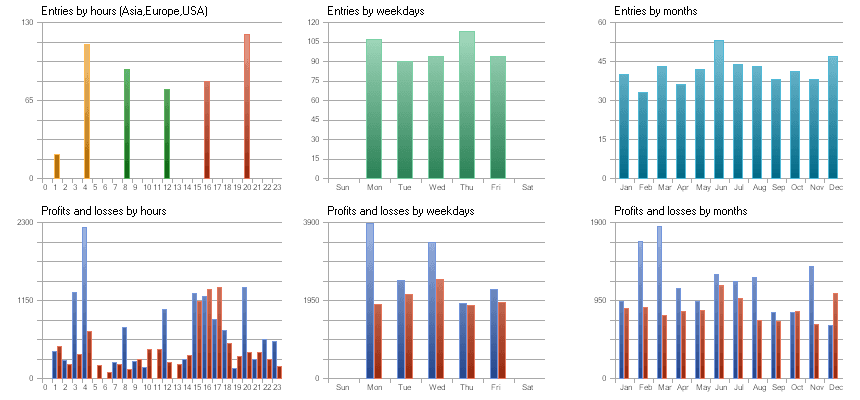
These sanitized XAUUSD research outputs are drawn from the same 9.30 MT5 replay used in the public evidence record. They show deal sequence, holding-period behavior and favorable-versus-adverse excursion.
The chronological trade record exposes clustering and inactive periods.
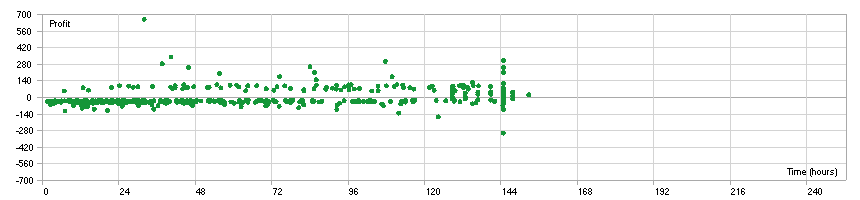
Time in trade helps distinguish system geometry from a generic return claim.
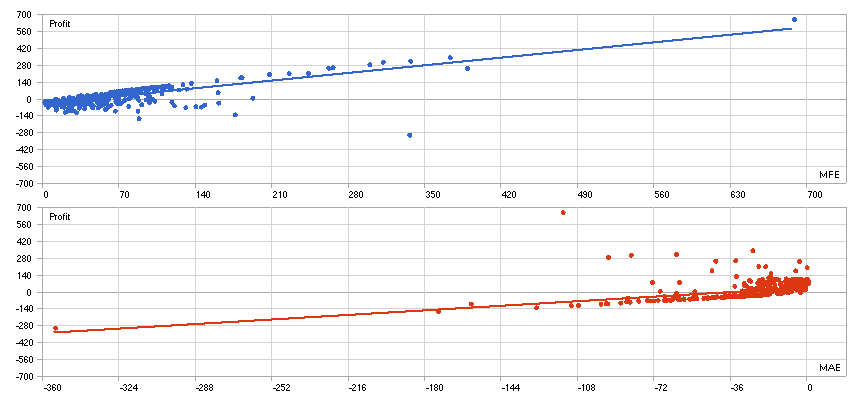
MFE and MAE show how far winning and losing trades travelled before exit.
The harness narrows uncertainty. It does not remove it.
- Backtests do not reproduce every live spread, slippage, gap or broker condition.
- Settings fitted with later data are not the same as a sealed policy holdout.
- Correlation and market regimes can change after the measured window.
- File availability and release controls do not establish live-forward profitability.